
Rocket Science. Political Science. Science. The Cosmos. Release.
We’re reminded of the vastness of space at every moment. No matter where you are, you’re always met with either the sun, the moon, or the stars. None of which exist on our beautiful Earth.
So we take their existence for granted and assume they’re out of our realm and unreachable. Even though humans did walk on the moon in the 60’s, but now, almost 7 decades later, it’s as if it never happened.
How can humans ignore the greatness and importance of outer space when they can’t even ignore a negative comment on cyber space? It’s easy for us to worry about what other people think of us, what hot new product is on the market, and what exclusive event celebrities attend; but we barely spend time thinking beyond our atmosphere. And maybe that’s how it should be, maybe that’s the secret purpose of our atmosphere- to confine us to Earthly matters. But then how come we were given brains that were able to create rockets that travel outside of that atmosphere? How were we able to put humans on a floating space station and a man on the moon? And what really is Earth if not a tiny part of outer space? Is there really such a thing as Earthly matters without the rest of matter?
Look at what humans can do with abstraction, we can think in levels above our physical limitations and senses. Abstraction caused the most significant developments in art, math, science, technology and society. Well, now think of abstraction when our entire base is a level above. When our senses experience what we never could have imagined. When we’re no longer confined to Earth. Where could abstraction elevate us to then?
Here and now we dream of what it would be like to travel around our galaxy and live in Mars. When that’s all easy and accessible, what would we be dreaming about then?
The disproportionate lack of interest in space could partially be blamed on the words “rocket science”. We’ve all heard the term “rocket science” used to denote an impossibly difficult task. Rocket science, or more technically aerospace engineering, involves many disciplines and requires the combination of various technical skills, each of which taken in isolation is considered complex. So you can imagine how complex the combination of them may seem. Some of the disciplines involved are physics (including aerodynamics and thermodynamics), mathematics, materials science, acoustics, avionics, software, manufacturing, and of course design and engineering. Imagine having expert knowledge in all of these – rocket science indeed.
Here’s the thing though, “rocket scientist” does not denote someone who excels in all these disciplines, it takes an entire team of subspecialists working together to actually build a rocket. Now that does not mean it’s easy, it just means it’s not as impossible as it seems. It’s not way over our heads. When we propose building a new city, people don’t think it’s difficult and we’re quick to get excited as the visualization of it is easy. But cities require the same aggregation of multiple disciplines and many people working together to build. So why has it been harder for people to visualize and get excited about space exploration?
This brings us to another culprit for space’s small fanbase – the fact that for most of its history, space was kept for governments, and if you didn’t work for them, you didn’t have the access to it. That was to change forever back at the turn of the century.
NASA was created in 1958 as the US’s response to Russia launching the first artificial satellite “Sputnik 1″in 1957. To the US, access to space is a matter of national security and technological superiority, and they had to compete. Due to its costs, risks, technological requirements and significance, space was the exclusive domain of governments. Over the decades, governments around the world established space programs in an attempt to protect national security and compete in the race to colonise space. Led by the US, China, and Russia, space is now inhabited by satellites and shuttles from Japan, the United Kingdom, India, Canada, Germany, France, and even Luxembourg.
As is common with government institutions, however, bureaucracy played a larger role in the US and politics shifted priorities away from space after the golden years of the 60’s and 70’s. Budget cuts to NASA pushed space exploration to the bottom of priorities, and innovation and advancement halted. Other governments were more active and US astronauts have been travelling on Russian vehicles. But in 2002, a young and ambitious South African decided to take matters into his own hands.
Having founded X.com which later merged with Paypal and made millions off of its sale to eBay, Elon Musk decided he wanted to build the company that would take humanity to Mars (and avoid the eventual extinction event he expected), and so he started SpaceX. Being an engineer himself, Musk focused on the craft of building rockets- creating (from scratch) better, cheaper, and more reliable vehicles than NASA and focusing on vertical integration. Considering the control governments had over the space industry, Musk struggled in the beginning as he tried to get NASA to take him seriously. After showcasing his first rocket Falcon 1 (which eventually blew up in 2006), suing NASA twice, and speaking against them in Congress, Musk forced and proved his way into a small $278 million contract with NASA. In 2008, the renovated Falcon 1 was the first privately developed liquid-fuel rocket in history to reach orbit- the first of many records to be accomplished by SpaceX. Musk secured $1.6 billion from NASA, and the contracts never stopped.
From then on, the dream of space startups, reusable rockets, and commercial space travel became a reality.
Simply note the characters that have embraced the commercial Space Industry:

Elon Musk & SpaceX 
Jeff Bezos & Blue Origin 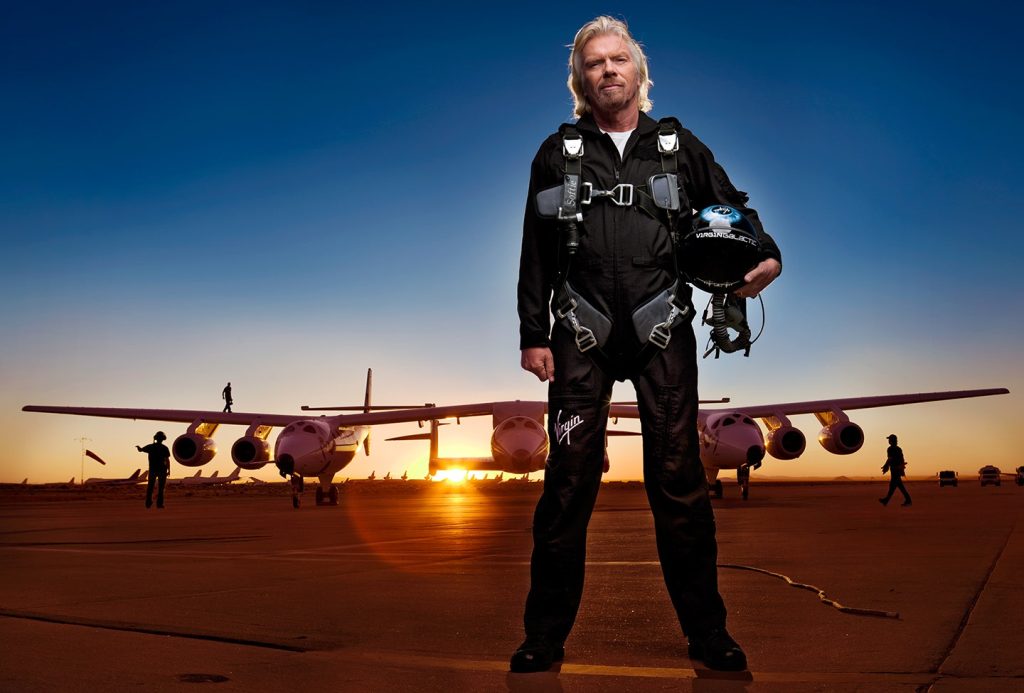
Richard Branson & Virgin Galactic
These are the guys responsible for building Tesla, Amazon, and the Virgin Empire – more importantly, these guys completely transformed transportation, commerce, and entrepreneurship. Now they’re building companies that aim to transform humankind.
Blue Origin was founded before SpaceX in the year 2000, but it took Elon’s larger-than-life character and courage to challenge the bureaucratic sentry of space and force them to open the field to anyone willing and capable. Private space companies bring the innovation, cost efficiency, and drive that the space industry lost in the last few decades- and desperately needed. NASA’s closest attempt at a reusable rocket was Delta Clipper Experimental (DC-X) in the 1990’s which was only able to reach several thousand feet, not space. Today, SpaceX and Blue Origin regularly fly rockets to orbit for NASA that boast dozens of trips per vehicle.
Private space companies are innovating in technology and business models, making space travel cheaper and more effective, and allowing organizations like NASA to do more missions and research, and ultimately have more capabilities in space. We still don’t know how many industries will benefit from space or how many will be created as a result, but we expect it may be THE market while Earth remains our home. Manufacturing, mining, energy, transportation, and construction are just a few that will be capitalizing on this new market. Elon Musk dreams of taking humanity to Mars, Jeff Bezos dreams of space startups being as easy to launch as internet startups, and Richard Branson dreams of a world where anyone gets to experience space.
It took 11 years since the founding of NASA to get Neil Armstrong and Buzz Aldrin on the moon. Now that commercial, private companies entered the game, how much longer do you think it will take to surpass that accomplishment? Some of the world’s most brilliant minds work at these startups that constantly pop up to join in the mission of expanding humanity to the cosmos.
How much room is there in space? Infinite- but the door is heavily guarded. And pace determines your access to that door. Those making strides today are building the infrastructure that everyone else has to pass through to access what promises to be the largest market us humans have ever seen.
There are many ways to get involved in space- you don’t have to be a “rocket scientist”. The easiest way is investing in and supporting the startups you believe will continue to contribute to the industry (I mean, this industry is GREAT for social distancing, so the timing seems ideal 🙂 ). Remember what the internet did to startups? Well the internet wouldn’t be possible without sending satellites to Earth’s orbit, and now that space is opening up, startups may have found their new incubator.
Considering the significance of this industry, governments around the world should be dedicating more and more in financial and human capital to have a stake in space. The GCC has lagged in building a space industry (with only the UAE and Saudi Arabia operating satellites), but with newly voiced interest from the UAE to develop launch capabilities and more, things may be picking up fast – at least I hope so.
The height of our interest in space was when we were children, as the dream seems more realistic when we’re ignorant of science and politics. There’s a great lesson to be learned from our youth- the dream always comes first, science and politics after. It took a few brave souls and the collaboration of brilliant minds to manage the obstacles in getting to space. Now, the first manned mission from US soil since 2011 is expected around May 27th- and the company delivering this was started by a young Elon Musk with a dream to travel to those lights in the sky. The lights we look at with wonder and awe every night may now be our final destination. Humanity has been released to the stars and beyond.
Get excited.
 Anwaar's Chronicles of Corona
One thought on “Spaces & Paces”